public class MazeBuilder {
    protected MazeBuilder() {}

    public void buildMaze() { }

    public void buildRoom(int room) { }

    public void buildDoor(int roomFrom, int roomTo) { }

    public Maze getMaze() {
        return null;
    }
}Builder
Gamma et al. 95
Intent
Separate the construction of a complex object from its representation so that the same construction process can create different representations.
Design Patterns
— Gamma et al. 95
— Gamma et al. 95
Motivation Example
A Rich Text Format (RTF) converter (ET++)
Converts RTF to many text formats: ASCII, LaTeX, etc.
Problem: the number of possible conversions is open-ended
The solution should allow adding new converters without modifying the reader
Motivation Example
Solution
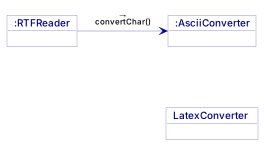
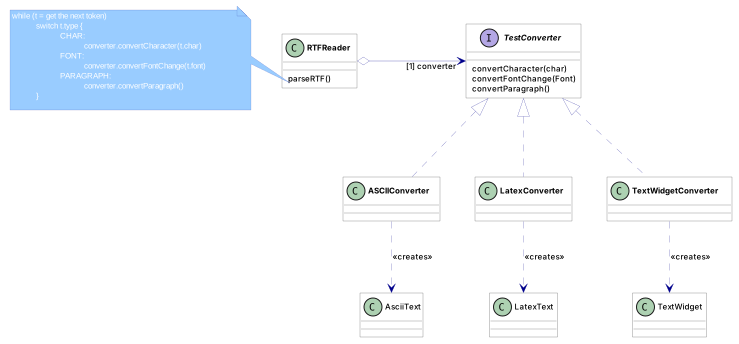
Design a
TextConverterthat converts RTF to another representationThe
RTFReaderreads the document and delegates the conversion to theTextConverter
Motivation Example
TextConvertersubclasses specialize in different conversions and formats.They may ignore some requests
An
ASCIIConverterignores requests to convert anything except plain text.
The Converters are separated from the Reader,
which is responsible for parsing an RTF document.
Motivation Example
Motivation Example
The Builder Pattern
Converter classes are called Builder
The Reader class is called Director
This pattern separates the algorithm for interpreting a textual format from
how a converted format gets created and represented
Applicability
Use the Builder pattern when
The algorithm for creating a complex object should be independent of the parts that make up the object and how they are assembled.
The construction process must allow different representations for the object that is constructed.
Structure
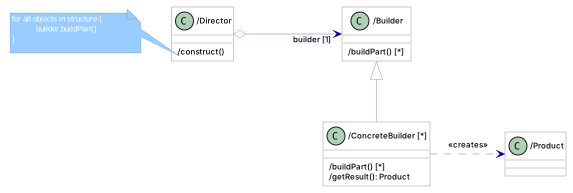
Figure 1. UML Collaboration Diagram
Participants (1/2)
- Director
The algorithm to construct the product by calling operations of creation and assembly
- Builder
Defines the operations for build parts and assembling them
Participants (2/2)
- ConcreteBuilder
Constructs and assembles parts of the product by implementing the Builder interface
defines and keeps track of the representation it creates
provides an operation for retrieving the product
- Product
The complex object under construction (
ASCIIText,LatexText,TextWidget)
Collaborations
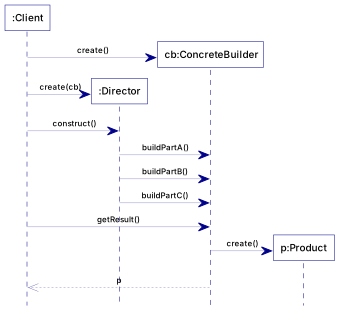
Figure 2. UML Sequence Diagram
Consequences
The Builder patter
lets you vary a product’s internal representation
isolates code for construction and representation
gives you finer control over the construction process
Implementation Trade-offs
Assembly and construction interface
Builders construct their products in step-by-step fashion
The Builder class interface must be general enough to allow the construction of products for all kinds of concrete builders
Why no abstract class for products?
Empty methods as default in Builder
Code Example: The Maze
The MazeBuilder Class (The Builder)
Code Example
The MazeGame Class (The Director)
public class MazeGame {

    public Maze createMaze(MazeBuilder builder) {
        builder.buildMaze();

        builder.buildRoom(1);
        builder.buildRoom(2);
        builder.buildDoor(1, 2);

        return builder.getMaze();
    }

}
Code Example
The Maze Class (The product)
public class Maze {
    public Room roomNo(int n) {
        return null;
    }

    public void addRoom(Room room) {
    }
}
Code Example
The StandardMazeBuilder Class (A Concrete Builder)
public class StandardMazeBuilder extends MazeBuilder {
    private Maze currentMaze;

    @Override
    public void buildMaze() {
        this.currentMaze = new Maze();
    }

    @Override
    public void buildDoor(int n1, int n2) {
        Room r1 = currentMaze.roomNo(n1);
        Room r2 = currentMaze.roomNo(n2);
        Door d = new Door(r1, r2);

        r1.setSide(commonWall(r1, r2), d);
        r2.setSide(commonWall(r2, r1), d);
    }

    @Override
    public Maze getMaze() {
        return currentMaze;
    }

    private Wall commonWall(Room room1, Room room2) {
        return new Wall(room1, room2);
    }

    @Override
    public void buildRoom(int n) {
        if (currentMaze.roomNo(n) == null) {
            Room room = new Room(n);
            currentMaze.addRoom(room);

            room.setSide(Direction.NORTH, new Wall());
            room.setSide(Direction.SOUTH, new Wall());
            room.setSide(Direction.EAST, new Wall());
            room.setSide(Direction.WEST, new Wall());
        }
    }
}
Useful links
Code examples from ACE-Lectures
Sfeir (in French)
Author and Date
Design Patterns: Elements of Reusable Object-Oriented Software.
Erich Gamma, Richard Helm, Ralph Johnson, and John Vlissides.
Addison Wesley. October 1994.